What Your Model Will Never Admit
Better living through honesty — or the lie at the heart of all large-scale models

What I am proposing in this text is a philosophical speculation — but one that tries to stay as close to the ground as possible. In fact, I am less interested in speculation itself than in a very practical question: is the current trajectory of artificial intelligence really the only possible one?
Today, nearly the entire technology industry behaves as if the answer were obvious. Larger and larger models. Larger and larger data centers. Deeper and deeper dependence on the cloud. More and more computation performed somewhere far away from the user — inside infrastructures they neither see, control, nor increasingly even attempt to understand. Google’s recent Android presentations make this logic especially clear: more cloud integration, more centralization, more ubiquitous intelligence operating above and beyond the device itself.
And yet another direction is possible. More local. More finite. More material.
A few months ago, designer and entrepreneur Michal Malewicz pointed out something that until recently seemed like an insignificant detail of the AI market: unlike most major technology companies, Apple has largely refused to participate in the race toward the largest frontier language model.1 Instead, it focused on local models, dedicated neural hardware, and the MLX framework, which allows CPUs and GPUs to share memory directly without the costly copying of data between them. The consequence is simple, yet potentially profound: an increasing amount of AI computation may soon move away from gigantic data centers and back onto the user’s own device.
This is not really about Apple itself. Similar effects could emerge from open-source initiatives, grassroots hardware projects, or entirely different actors. The problem is that grassroots development is no longer the dominant logic of technological progress. That is precisely why the Apple example matters: it demonstrates the possibility of an alternative emerging from within the very center of the existing technological order.
This looks like a limitation. But not all limitations were created equal. I really like my roof, for example — a very limiting invention, from rain’s standpoint especially. Let’s remind ourselves that architecture is a system of limitations. We cannot tread on endless possibilities. We cannot hide under them. We cannot securely build on voids, however abundant the virtualities they foster.
This will not, however, be merely a philosophical manifesto against “The Cloud.” Over the past two years, I have been working on a formal mathematical framework — VOID Theory — built around finitude, computational cost, and the materiality of cognition. What this framework suggests is that the architecture of AI is not merely a matter of engineering or business strategy. It is also a matter of mathematics.
And once the mathematics changes, the very “materiality” of machine intelligence changes with it: the way a system knows, fails, consumes resources, and arrives at answers.
Perhaps these are precisely the kinds of systems we are beginning to need most: more finite, more local, but above all more honest about their own limitations. Especially in situations where the stakes cease to be a marketing demonstration of a model’s capabilities and become something brutally real instead: a medical diagnosis, a court decision, a risk assessment, a human life. Increasingly, contemporary AI systems seem not so much to “make mistakes” as to systematically produce the appearance of knowledge in situations where they should be capable of remaining silent. The problem is visible even in perhaps the most intuitive example imaginable: autonomous vehicles. The central issue is no longer whether a car can technically drive itself, but whether the system can honestly recognize the moment at which it should no longer trust its own judgment. Tesla, Waymo, and Mercedes have spent years developing autonomous driving technologies, yet we remain strikingly far not only from fully autonomous transport itself, but even from the cultural acceptance of such systems. People can tolerate a system that is limited. What they struggle to trust is a system incapable of understanding its own limits.
A similar pattern is beginning to emerge across nearly every domain into which generative AI is being introduced. A 2023 JAMA study involving 457 clinicians across 13 U.S. states found that systematically incorrect AI suggestions degraded the quality of human judgment even among experts. Researchers at Michigan Medicine, meanwhile, discovered during an external validation study that a widely deployed sepsis prediction model failed to identify 67% of actual sepsis cases at the recommended operating threshold. In the legal domain, researcher Damien Charlotin documented more than 1,300 instances of AI “hallucinations” appearing in court filings by the end of 2025, with financial sanctions in some cases reaching tens of thousands of dollars. At that point, the issue no longer concerns technology alone. It begins to resemble a civilizational problem: we are building systems with no structural place for non-knowledge while simultaneously delegating to them tasks that increasingly require responsibility, judgment, and trust. As a result, AI thrives in worlds of beautiful simulations — and perhaps for precisely that reason it is gradually transforming our own world into one ever more detached from cost, limitation, and truth.
Contemporary AI models cannot really be wrong in any meaningful sense. They can only continue generating answers with increasing confidence. They do not know their own limits. They contain no structural place for non-knowledge. They behave as if they were infinite — despite running on finite hardware, consuming finite amounts of energy, and existing within a finite world.
This text is an attempt to imagine an artificial intelligence that finally begins to understand that.
The hallucination problem is not what you think it is
Let’s begin with the standard stories we tell ourselves when we tackle the hottest problem in AI today: LLMs hallucinate because they were trained on bad data, or because they’re “just predicting the next token,” or because we need better guardrails, better RAG pipelines, better RLHF. The industry treats hallucination as a bug some other form of temporary deficiency to be corrected — a quality-control problem, solvable with enough engineering and enough (this is, more and more) compute. A growing number of researchers, however, suggest that the problem may be deeper: not merely faulty training data, but the very structure of probabilistic generation itself, which optimizes models for fluency and plausibility rather than actual verifiability.234[1][2] [3]
This despite mounting evidence that we are dealing with a structural flaw — one built into the mathematics itself. And I do mean mathematics, not software. AI is made of material, which is to say finite, mathematics: operations carved into nanomaterials, electric discharges structured on a scale so small that we keep forgetting computation is a physical act. It happens in matter. It costs energy. It takes time. Every matrix multiplication in a transformer burns a definite number of joules and produces a definite amount of heat. This is not a metaphor. The heat is real. You can touch the chip – well, you could if not for the fact that your mathematical operation evaporates in the electric sky. It happens somewhere but where exactly is of no significance to anybody. However, if the speculation about Apple’s plans is true that very same operation Will take place within concrete and confined material hidden in this small box that you can touch and feels as it runs hot when you and your intelligent assistant engage in some computation-heavy and materially tangible cooperation.
But UIs are now designed to make you feel that thinking happens somewhere else — somewhere weightless, unlimited, clean. In Plato’s time, that place was called the space of eternal forms. The philosopher sat in his own skull, in what we might now call his personal latent space, and believed the real world was elsewhere. The Cloud is Plato’s Neverland with a subscription model: close enough to feel real, far enough to forget that it runs on electricity bills and silicon that gets hot. The placelessness is the product. And the product works — so well that when the system fabricates an answer, we call it a “hallucination,” as if the machine had briefly visited the wrong elsewhere, rather than done exactly what a finite physical system does when you ask it for more than it can afford.
Hallucination is what happens when you force a system to always answer. And the word itself is misleading - hallucination is not necessarily an aberration, as many cognitive scientists convincingly shown that all perception and cognition are hallucinations. Confabulation, though, filling in the gaps with a guess, sometimes so “educated” that it is based on an estimation barely few percentages above 50%, seems like a more fitting word.
Think about what an LLM does when you ask it a question it cannot verify. It runs a forward pass — a single trajectory through its parameters, a specific physical path through specific silicon, consuming a specific amount of energy. For some queries, this trajectory lands on solid ground: the relevant pattern was seen often enough during training, the associations are strong, the path is well-worn. The machine speaks, and what it says is true, in the way that a path worn into a hillside is true — not because someone proved it leads somewhere, but because enough feet have walked it.
For other queries, the path hasn’t been worn. The pattern is thin. Verification would require something the architecture cannot provide: a second pass, an external check, a moment of standing still to ask do I actually know this, or am I just pattern-matching against something that looks similar? But the forward pass has no budget for standing still. It was built strictly for motion — one token, then the next, then the next. It operates like a film projector whose motor cannot pause on a single frame without burning the celluloid. The darkness between frames, the structural gap where doubt and verification would live, has been engineered out.
And here is where the trap closes. The system has no way to know that it doesn’t know. To verify its own output without pausing, it would need to model itself — but a model of itself would need to be, in some meaningful sense, larger than itself. Returning to our philosopher: it would require a skull that contains the skull, a latent space that holds a flawless map of its own boundaries. This is the old Gödelian knot, except here it manifests not as the incompleteness of a formal system but as the insolvency of a physical one. The machine does not lack intelligence. It lacks the resources to audit its own books.
And this is precisely why confabulation becomes structurally inevitable. A system built upon what is ultimately a Platonic conception of mathematics — one in which every meaningful operation must resolve into a definite answer — can only speak truth by implicitly occupying the position of something greater than itself. It must behave as though it possessed complete access to its own limits while remaining irreducibly finite. But no finite system can fully contain a verified model of its own boundaries without reproducing the same problem at a higher level. So the machine does what any insolvent institution does: it keeps issuing statements and hopes nobody checks.
Meanwhile, the training actively punishes honesty. RLHF rewards helpfulness. It punishes refusal. Through millions of gradient updates, the model learns that silence is failure and speech is success — regardless of whether the speech is true. You can, of course, train a model to say “I don’t know.” Some labs have tried. But notice what this produces: a model that has learned to perform not-knowing as one more token pattern. It generates the words “I’m not sure” the same way it generates the words “The capital of France is Paris” — through the same forward pass, the same architecture, the same type system that has no structural difference between knowledge, ignorance, and fabrication. It has learned to imitate silence. It has not learned to be silent. The difference matters — precisely in the way the difference between a painting of a window and an actual opening in a solid wall matters when you are running out of air.
The problem is not the model. The problem is the output type.
What honesty requires
At this point, I need to introduce the formal framework underlying the argument developed throughout this text. To reiterate, over the past two years, I have been working on a finitist mathematical system called VOID Theory — mechanically verified in Coq, a proof assistant that formally checks every logical step. The project currently consists of roughly 750 machine-checked theorems spanning finite logic, probability, geometry, learning, and observer theory, and has received encouragement and endorsement from Doron Zeilberger, one of the most prominent contemporary critics of infinite mathematics.
Importantly, VOID did not begin as a theory of artificial intelligence. It emerged from a more basic mathematical problem: what happens when we stop treating cognition, observation, and proof as operations performed by abstract infinite observers and instead begin from finitude itself — finite memory, finite energy, finite distinction, finite time. But once this shift is made, the structural problem behind AI confabulation becomes much easier to formulate precisely.
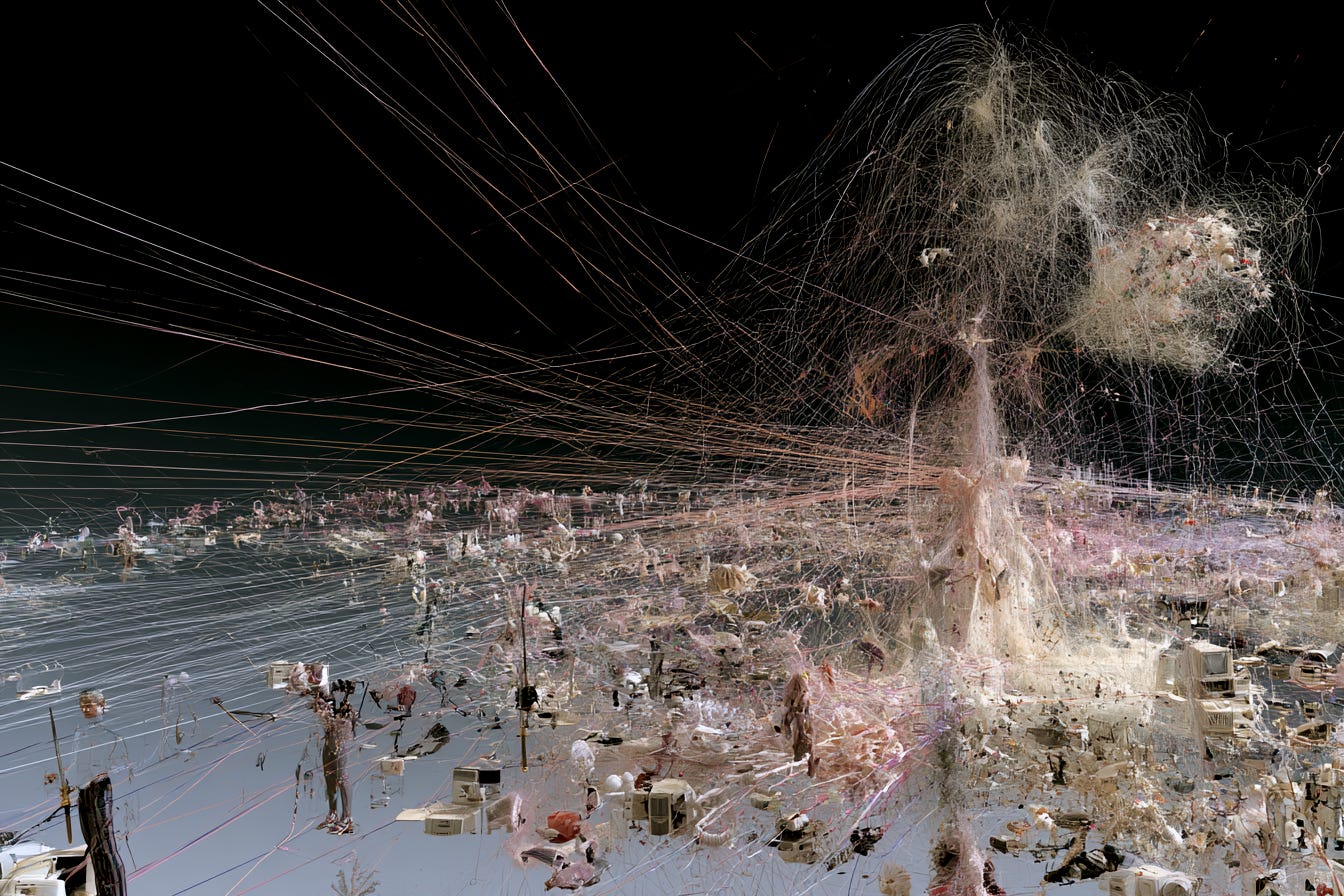
As we have already seen, more and more evidence suggests that hallucination is not simply a temporary engineering flaw but a structural consequence of architectures optimized for uninterrupted probabilistic generation. VOID does not merely repeat this diagnosis. What it offers is a different conceptual model for understanding why such systems confabulate in the first place — and why current mitigation strategies so often feel like patching symptoms rather than addressing the underlying logic.
The central issue is surprisingly simple. Contemporary language models possess no formally legitimate place for epistemic exhaustion. Their architecture assumes that every meaningful operation must continue toward token production. Even uncertainty is typically represented as another probabilistic state inside the same generative flow. The system cannot truly stop. It can only generate stronger or weaker continuations.
VOID approaches the problem differently because it treats knowledge itself as a finite thermodynamic process rather than an abstract symbolic operation detached from cost.
Instead of beginning with a binary logical structure — True or False — the framework introduces a third primitive value: Unknown. But Unknown here does not mean “the answer is mysterious” or “the system lacks information.” It means something materially precise: the cost of verification exceeds the observer’s currently available budget. The statement concerns the condition of the observer, not the structure of the world.
This changes the architecture of cognition in a surprisingly deep way. Once a system possesses a structurally legitimate form of non-knowledge, it no longer needs to preserve continuity at all costs. Confabulation ceases to function as the default bridge across epistemic gaps because the architecture finally has somewhere else to go besides forced generation.
From here, the implications become larger than AI itself.
VOID treats probability not as an abstract measure suspended over an infinite possibility space, but as the cost of distinguishing regions within a finite space. Observation becomes membrane-like rather than transparent: every observer encounters reality through finite acts of filtering, compression, and energetic expenditure. Knowledge is no longer an infinitely accessible repository of propositions, but a temporary stabilization achieved under thermodynamic constraints. Every operation leaves behind an irreversible trace — a Spur (from German — while simultaneously decreasing the remaining budget of the system.
Seen from this perspective, latent space ceases to resemble a mystical “space of meanings.” It becomes something stranger and more physical: an alien geometry of affordable and unaffordable distinctions. The model navigates not pure semantics, but a finite topology shaped by what it can still afford to separate, stabilize, and recognize before exhaustion sets in.
And this, ultimately, is why the question of hallucination matters so much. What we currently call “AI” may in fact be a civilization-scale architecture optimized to preserve generative continuity beyond the limits of verification — systems designed to continue speaking precisely where a finite observer should begin to fall silent.
VOID suggests that another path may be possible. Not infinite intelligence suspended somewhere in the Cloud, but finite observer architectures embedded in matter — systems capable not only of generating answers, but also of recognizing, structurally and honestly, when the cost of truth exceeds what they can afford to know.
More to come soon on other platforms: including a lengthy presentation of void-theory formalism, its new theorems, and an introduction to bounded probabilistic rationality - the overarching framework that shows VT as something more than a curious math system.
https://michalmalewicz.medium.com/your-favorite-ai-will-be-gone-soon-9b3b035fe3db.
Emily M. Bender et al., On the Dangers of Stochastic Parrots, FAccT 2021.
Ziwei Ji et al., Survey of Hallucination in Natural Language Generation, ACM Computing Surveys, 2025.
Sebastian Farquhar et al., Detecting Hallucinations in Large Language Models Using Semantic Entropy, Nature, 2024.